Producer
Schloss Johannisberg
 Rheingau, Germany, Germany
Schloss Johannisberg has a documented viticultural history that begins in 817 when Emperor Ludwig the Pious acquired the first vineyards on the site. A Benedictine monastery was established on the hill around 1100, and the location was named after John the Baptist shortly thereafter. In 1716, the Prince-Abbot of Fulda purchased the property and began the construction of the present Baroque palace. Following the Napoleonic Wars, Emperor Francis I of Austria granted the estate to Prince Klemens von Metternich in 1816 as a reward for his work at the Congress of Vienna. The Metternich family maintained a long association with the property until the late 20th century. Today, the estate is owned by the Oetker Group through its Henkell Freixenet wine and spirits division.
The estate operates a 50 hectare monopole vineyard situated on a steep hill that rises up to 182 meters above sea level. This site is located directly on the 50th parallel north, where the vines benefit from significant temperature shifts between day and night. The soil consists primarily of Taunus quartzite covered with loam and loess, providing a distinct mineral foundation for the grapes. The vineyard has an inclination of 45 degrees, allowing for optimal sunlight and natural drainage toward the Rhine River. In the cellar, the wines are aged in stainless steel or large wooden barrels. These barrels are crafted using oak harvested from the winery's own 300 hectare forest, which helps maintain a connection between the local landscape and the finished wine.
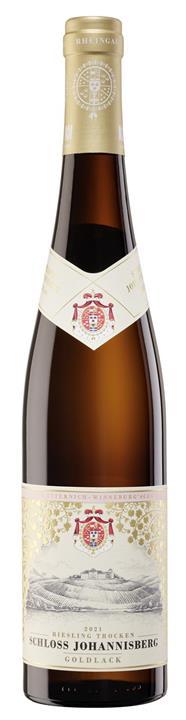
Schloss Johannisberg is the first winery in the world to be planted exclusively with Riesling, a transition that occurred in 1720 under the direction of the Prince-Abbot of Fulda. The estate is widely recognized as the birthplace of the Spätlese category, which was discovered by accident in 1775 when a harvest messenger was delayed for two weeks. This delay allowed the grapes to develop noble rot, leading to a new style of concentrated sweet wine. The producer uses a traditional color coded system for its bottle capsules to distinguish between quality levels, including yellow for basic wines, red for Kabinett, and green for Spätlese. The estate also claims the first production of Eiswein in 1858 and remains a founding member of the VDP. Beneath the palace lies the Bibliotheca Subterranea, a 900 year old cellar housing approximately 25,000 historic bottles, the oldest of which dates back to 1748.