Producer
Grosset
 Clare Valley, South Australia, Australia
Jeffrey Grosset founded his eponymous winery in 1981 in the small town of Auburn, located at the southern edge of the Clare Valley. Before establishing the estate, he studied agriculture and oenology at Roseworthy College and served as a senior winemaker for larger commercial operations. The winery itself is housed in a heritage stone building that previously functioned as a dairy and butter factory in the early 1900s. Grosset remains an independent, family owned business, with Jeffrey overseeing operations alongside a long standing production team. His partner, Stephanie Toole, maintains her own separate winemaking operation at Mount Horrocks within the same region.
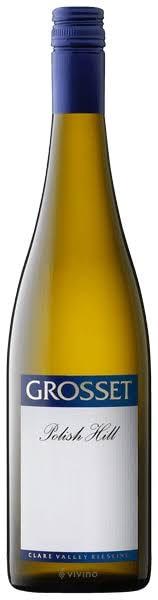
The estate manages four principal vineyards, all of which are A-Grade certified organic and biodynamic by the Australian Certified Organic body. These sites, situated in the cooler high country of the Clare Valley, range from 460 to 560 meters in elevation. The Polish Hill vineyard is characterized by its thin, rocky topsoil over 500 million year old blue slate, producing wines with high mineral intensity. In contrast, the Springvale vineyard features red loam over limestone and slate, resulting in a more floral and approachable profile. Winemaking is defined by a minimalist approach that emphasizes varietal clarity and site specificity, with all fruit hand picked and hand sorted.
Grosset is widely recognized for its contribution to the global standing of Australian Riesling. In 2000, Jeffrey Grosset led a group of Clare Valley producers to adopt screwcap closures, a move that significantly altered the packaging standards for the Australian and New Zealand wine industries. The estate’s Polish Hill Riesling is frequently cited as a reference point for the variety, often appearing in the highest category of the Langton’s Classification of Australian Wine. Beyond Riesling, the producer is known for the Gaia Cabernet blend, sourced from a rocky, high altitude vineyard, as well as Chardonnay and Pinot Noir from the Adelaide Hills. Annual production is restricted to approximately 11,000 cases to maintain quality control.
Wines from Grosset
4 wines South Australia (Clare Valley)
Grosset Alea Riesling
Grosset · 2025
Riesling
 South Australia (Clare Valley)
Grosset Polish Hill Riesling
Grosset · 2025
Riesling
 South Australia (Clare Valley)
Grosset Springvale Riesling
Grosset · 2025
Riesling
 South Australia (Clare Valley)
Grosset Polish Hill Riesling
Grosset · NV
Riesling