Producer
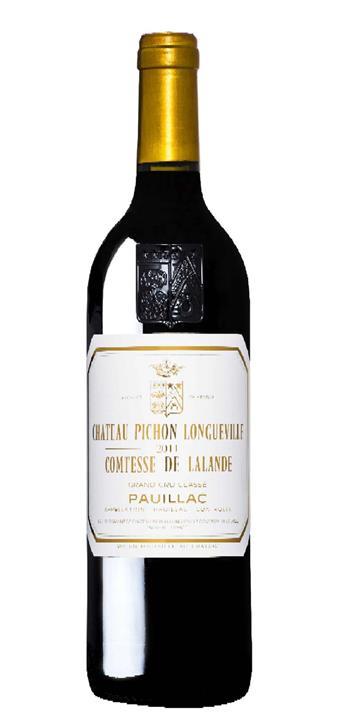
Château Pichon Longueville Comtesse de Lalande
 Pauillac, Bordeaux, France
Pierre de Mazure de Rauzan founded the original estate in 1689 after purchasing several vineyard parcels in Pauillac. His daughter Thérèse received the land as a dowry for her marriage to Jacques de Pichon Longueville, the first President of the Parliament of Bordeaux. For over 150 years, the property remained a single entity until the death of Baron Joseph de Pichon Longueville in 1850. The Baron divided his land among his five children, with the share given to his three daughters eventually forming the current estate under the leadership of Virginie, the Comtesse de Lalande. The Miailhe family acquired the property in 1925, and it was later managed by May Eliane de Lencquesaing from 1978 until its sale to the Rouzaud family, owners of Champagne Louis Roederer, in 2007.
The estate manages approximately 89 hectares of vines situated near the Gironde estuary, which helps moderate local temperatures and protect against frost. The soil composition features deep Garonne gravel over a layer of clay and limestone, providing natural drainage and heat retention for the vines. Although the vineyard was historically distinctive for its large proportion of Merlot, current management has increased the presence of Cabernet Sauvignon to roughly 70 percent of the blend. Nicolas Glumineau, who joined as general manager in 2012, oversees a modern cellar equipped with truncated stainless steel vats of varying sizes. This facility allows for precise vinification of individual parcels. The estate also incorporates biodynamic viticulture across more than 30 hectares of its total surface area.
This producer was designated a Second Growth in the 1855 Classification. It is widely regarded as a super second, a term used for estates that produce quality consistent with the five first growth châteaux. The resulting wines are often described as having a characteristic balance of power and finesse, featuring fine tannins and complex aromatics of cedar and blackcurrant. The flagship wine spends 18 months in French oak barrels, with a significant percentage of new wood used each year. The property also produces a second wine named Réserve de la Comtesse, which has been in production since 1973. This wine offers an expression of the estate's terroir that is approachable at a younger age while maintaining the same commitment to precision and elegance.