Producer
Château Lynch-Bages
 Pauillac, Bordeaux, France
Thomas Lynch, the son of an Irish merchant from Galway, acquired the estate in 1749 through his marriage to Elisabeth Drouillard. The property remained in the Lynch family for 75 years before being sold to the Cayrou family in 1824. Jean-Charles Cazes, who had been a tenant farmer at the property since 1934, purchased the estate in 1939. His son André Cazes subsequently took over management and served as the mayor of Pauillac for several decades. Jean-Michel Cazes, André's son, led the winery from 1973 until 2006, overseeing technical modernizations and global marketing efforts. The estate is currently managed by his son, Jean-Charles Cazes, representing the fourth generation of the family.
The vineyard holdings cover approximately 105 hectares within the Pauillac appellation. These lands are located on the Bages plateau, where the topography reaches heights of 20 meters. The soil is composed of deep Garonne gravel which provides natural drainage and sits over a marl and limestone subsoil. Cabernet Sauvignon is the primary variety, making up roughly 75 percent of the vineyard. The remaining land is planted with Merlot, Cabernet Franc, and Petit Verdot. A modern production facility was completed in 2020, featuring a gravity-fed cellar designed by architect Chien Chung Pei. This facility uses 80 stainless steel vats of varying sizes to allow for precise vinification based on specific vineyard plots.
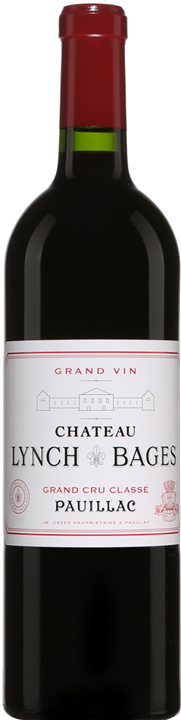
The primary wine is the Grand Vin, Château Lynch-Bages, which was classified as a Fifth Growth in the 1855 Classification of Médoc wines. Market observers and critics frequently group the estate with higher-growth properties due to its historical performance and market value. The producer also makes Echo de Lynch-Bages, a second red wine that was previously labeled as Château Haut-Bages Averous. In 1990, the Cazes family introduced Blanc de Lynch-Bages, a white wine produced from roughly six hectares of vines. This white blend consists of Sauvignon Blanc, Sémillon, and Muscadelle. The red wines are characterized by their concentration and firm tannin structure, typically requiring several years of cellar age to reach maturity.