Producer
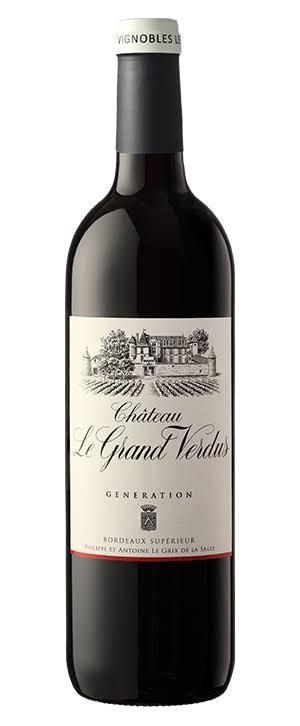
Château Le Grand Verdus
 Bordeaux Supérieur, Bordeaux, France
Château Le Grand Verdus is situated in Sadirac, within the Entre-Deux-Mers region of Bordeaux. The property centers on a Renaissance-style manor house constructed in 1579 on the site of a medieval fortress. The Le Grix de la Salle family has been associated with the estate since the mid-19th century, following its acquisition in 1846 by the architect Claude Deschamps. Ownership eventually passed to Charles Le Grix de la Salle, the brother of Deschamps' daughter-in-law. While the land has supported vines since the 11th century, the transition to a dedicated commercial winery occurred after the Second World War under Philippe Le Grix de la Salle. In 1973, Philippe chose to leave the local cooperative to produce and bottle wines independently under the estate label, aided by advice from the oenologist Emile Peynaud. Today, brothers Thomas and Edouard Le Grix de la Salle manage operations alongside their father, Antoine.
The estate encompasses 115 hectares of vineyards distributed across a hilly landscape with elevations reaching up to 110 meters. This varied topography creates a mosaic of 50 distinct plots with soils including clay, limestone, and gravelly deposits. Vineyard management emphasizes biodiversity and agroecology, which led to High Environmental Value certification in 2018 and full organic certification beginning with the 2023 vintage. In the cellar, the winemaking team utilizes a combination of stainless steel and concrete tanks for temperature controlled fermentation, alongside French oak barrels and clay amphorae for aging. Grapes undergo rigorous sorting before processing and harvests are frequently conducted at night to preserve fruit freshness. Recent plantings include Syrah and Chenin Blanc, varieties not traditionally associated with Bordeaux, intended to increase the resilience of the vineyard.
The winery is primarily recognized for its AOC Bordeaux Supérieur reds and dry white wines, producing a range of approximately 15 different cuvées. Notable offerings include the Grande Réserve, which is sourced from the most favorable clay-limestone parcels, and the Les Originales series that focuses on single-varietal and parcel-specific expressions. The estate has attracted critical interest for innovative projects such as Vertige Solera, a non-vintage white wine made from Sémillon using a perpetual reserve system, and Les Petites Bulles, a sparkling Blanc de Noirs made via the ancestral method. Departing from the traditional Place de Bordeaux merchant system, the family manages its own global distribution. This autonomous approach has allowed the estate to reach over 35 countries, placing its wines in markets ranging from Europe to East Africa and Central America.