Producer
Château Clerc Milon
 Pauillac, Bordeaux, France
Château Clerc Milon originated as part of the extensive Lafite seigneury before being sold as a national asset during the French Revolution. The Clerc family acquired the estate in 1789, eventually adding the name of the neighboring hamlet, Milon, to the property title in 1850. Despite its inclusion as a Fifth Growth in the 1855 Classification, the estate suffered from neglect and fragmentation throughout the early 20th century. In 1970, Baron Philippe de Rothschild purchased the property, which then consisted of only 16.5 hectares of vines. Ownership remains within the Rothschild family, managed today by the third generation, including Camille Sereys de Rothschild, Philippe Sereys de Rothschild, and Julien de Beaumarchais de Rothschild.
The estate encompasses 41 hectares of vines situated in the northern part of the Pauillac appellation, bordering the first growth vineyards of Mouton Rothschild and Lafite Rothschild. The terroir consists primarily of deep sandy gravel atop a clay limestone subsoil, located on the Mousset crest overlooking the Gironde estuary. The vineyard maintains an average vine age of over 50 years and contains a rare genetic heritage, including a significant plot of Carménère planted in 1947. Winemaking facilities were modernized with a gravity-fed vat room in 2007 and a new cellar building in 2011. Under the direction of Caroline Artaud, the wine undergoes aging for 18 months in French oak barrels, with 50 percent typically being new wood.
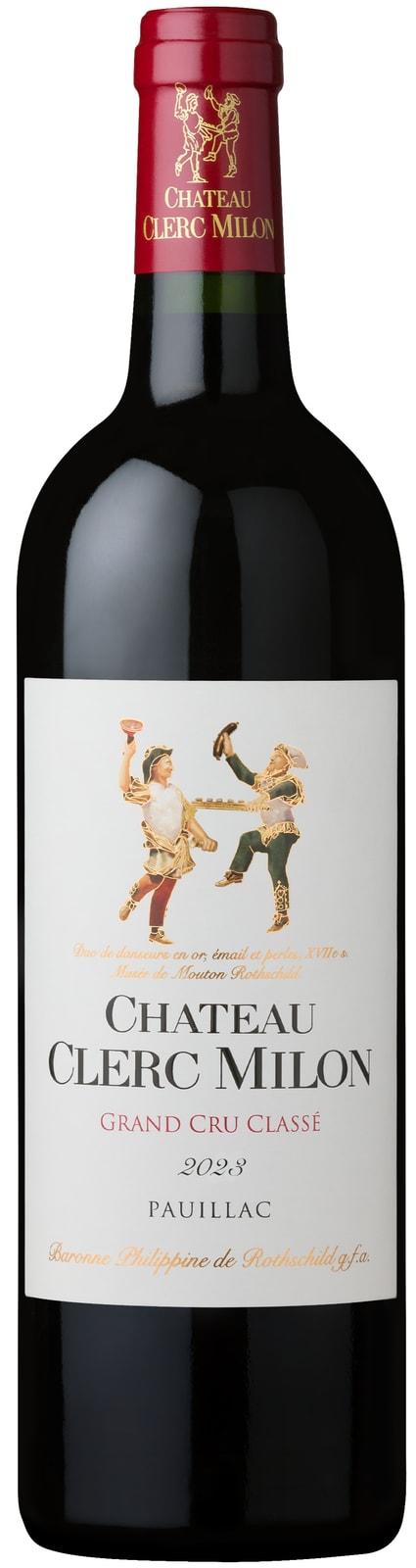
The primary wine is the Grand Vin, Château Clerc Milon, which is recognized by its label depicting two dancing figures inspired by 17th century goldsmith work in the Museum of Wine in Art. Since the 2009 vintage, the estate has also produced a second wine called Pastourelle de Clerc Milon, named after a traditional dance. The property has a reputation for producing wines that balance the power of Pauillac with a specific precision and aromatic complexity. It is frequently noted for possessing one of the highest proportions of Carménère in the Médoc, contributing to a distinct flavor profile that differentiates it from its neighbors.