Producer
Arnaud Roux-Oulié
 Fronsac, Bordeaux, France
Arnaud Roux-Oulié represents the third generation of his family to cultivate vines in the Fronsac region of Bordeaux. The family legacy began in the 1950s when his grandfather, Ernest Roux, acquired Château Lagüe. Following a period where the estate was managed by his mother, Françoise Roux, Arnaud assumed control of the business at the age of 20. In 1998, he diversified the family holdings by purchasing an initial two hectare parcel to establish his own specific estate, Château Carlmagnus. This name was selected as a historical tribute to Emperor Charlemagne, who is said to have built a fortress in the area. Over the following decades, Roux-Oulié expanded his management to include several other properties, including Château Vincent, Château Montcanon, and the Bordeaux Supérieur estate Francs-Magnus, which he purchased in 2011.
The vineyards are situated on the naturally drained clay-limestone plateaus and slopes that define the Fronsac and Canon-Fronsac landscapes. Total holdings across his various properties extend to roughly 38 hectares, where the average age of the vines is 25 years. Merlot is the primary variety, accounting for 90 percent of the vineyard area, while Cabernet Franc makes up the remainder. The viticultural approach has evolved toward environmental sustainability, with a formal transition to organic farming initiated for the 2020 vintage at both Carlmagnus and Francs-Magnus. In the cellar, the winemaking process involves vinification in temperature-controlled wooden vats. The wines typically undergo aging in French oak barrels, often utilizing a significant proportion of new wood to enhance the structure and aging potential of the Merlot-heavy blends.
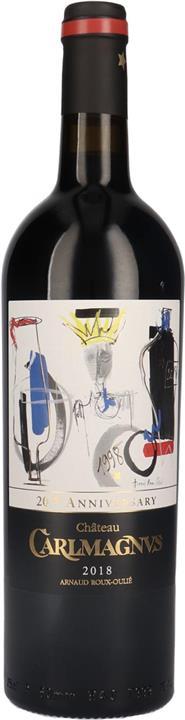
The flagship wine of the producer is Château Carlmagnus, which has gained a reputation for being a prominent and internationally distributed example of modern Fronsac. A defining characteristic of the estate is the personal involvement of Roux-Oulié in the visual identity of the bottles. As a professional painter and a former national fencing champion, he began creating original artwork for the wine labels starting with the twentieth anniversary 2018 vintage. Beyond red wine production, the estate recently introduced Alba Magnus, a white wine produced from limestone-rich soils. The property has also integrated gastronomy into its operations with the opening of a restaurant named Magnus La Table and the development of guest rooms, positioning the estate as a central destination for wine tourism in the Fronsadais region.